
SDG 4: QUALITY EDUCATION
Al Ain University


Contents
- Inclusive Access and Non-Discrimination Policy
- 1. AAU ensures inclusive access through a formal policy framework
- 1.1 Public availability and institutional accountability
- 2. The Non-Discrimination Policy defines protection, scope and remedy
- 3. AAU protects diversity across identity, background and circumstance
- 3.1 Students and staff are covered by complementary instruments
- Code of Conduct
- 4. The policy governs participation in resources, events, training and outreach
- 4.1 Equal opportunity across the academic community
- 5. Policy protection is reinforced by dedicated people, facilities and practice
- 5.1 Dated 2024 implementation
- 6. Recruitment, development, research and management follow equal-opportunity controls
- 7. AAU provides reporting, care, monitoring, referral and accountability routes
- 7.1 Awareness and specialist partnership
- 8. AAU rejects discrimination and promotes respect, tolerance and participation
- 9. QAA's 2024 International Quality Review confirms policy implementation
- 9.1 Demonstrated diversity
- 10. Inclusive access remains active in 2025-2026
- 11. AAU meets THE Indicator 4.3.5
- 11.1 Submission evidence summary
- 12. Evidence register
- 12.1 Support, employment, research and accessibility
- 12.2 Inclusion, implementation and independent review
- 12.3 Participation, human rights and current continuity
SUSTAINABLE DEVELOPMENT GOAL 4
Inclusive Access and Non-Discrimination Policy
DIRECT RESPONSE: YES - FORMAL, PUBLIC, INSTITUTION-WIDE POLICY
Al Ain University maintains a published Non-Discrimination Policy and supporting student, staff, grievance, counselling, discipline, recruitment, professional-development, research and accessibility frameworks. Together they require fair and equal treatment and protect access to University educational resources, public events, short courses, vocational training and outreach activities without discrimination on grounds including gender, marital status, ethnicity or nationality, age, religion, disability or special needs.
INSTITUTIONAL RESPONSE
1. AAU ensures inclusive access through a formal policy framework
Al Ain University's response is Yes. Its publicly available Non-Discrimination Policy establishes respect, equality and fair treatment as University requirements. It identifies protected characteristics, applies to employees and students, extends the University's non-tolerance statement to faculty, administrative staff and other stakeholders, and connects reporting to formal grievance procedures. The policy is supported by current student and staff handbooks and by dedicated student, staff, faculty, counselling, health and discipline procedures.
This framework applies to the educational resources, public lectures and community events, executive education and vocational training, and beyond-campus educational outreach described under SDG 4.3.1-4.3.4. Admission to an activity, participation, support and treatment must therefore be administered through the same institutional commitment to equality and respect.
Indicator requirement | AAU control | People protected | Evidence of operation |
Policy applies University-wide | Published Non-Discrimination Policy, approved governance and public policies architecture | Students, employees and other University stakeholders | Policy, handbooks and QAA independent review |
Access regardless of ethnicity or religion | Express protection for ethnicity or nationality and religion; diversity commitment for all backgrounds and origins | Learners, staff, applicants, partners and participants | Diversity statement and tolerance programming |
Access regardless of gender | Express gender and marital-status protection, fair employment controls and reporting routes | Students and staff of all genders | Recruitment, grievance, counselling and discipline framework |
Access regardless of disability | Express protection for disability or special needs plus dedicated support and accessible facilities | People with physical, sensory or learning-support requirements | Support Office, facilities and 2024 inclusion activity |
Access to SDG 4.3 activities | Equal-treatment framework governs resources, public learning, short courses and outreach | Enrolled and non-enrolled participants | Institutional policy plus operational services |
Public evidence: E01 | E02 | E03 | E04 | E05 | E08 | E09 | E11
1.1 Public availability and institutional accountability
AAU publishes the Non-Discrimination Policy within its University Policies architecture and publishes the associated policies and handbooks through its website. Governance approval, Human Resources implementation, the Deans' Council, student and staff grievance routes, and discipline processes convert the commitment into an accountable institutional control rather than a stand-alone statement of values.
Public evidence: E04 | E05 | E06 | E08 | E14 | E18 | E19 | E20
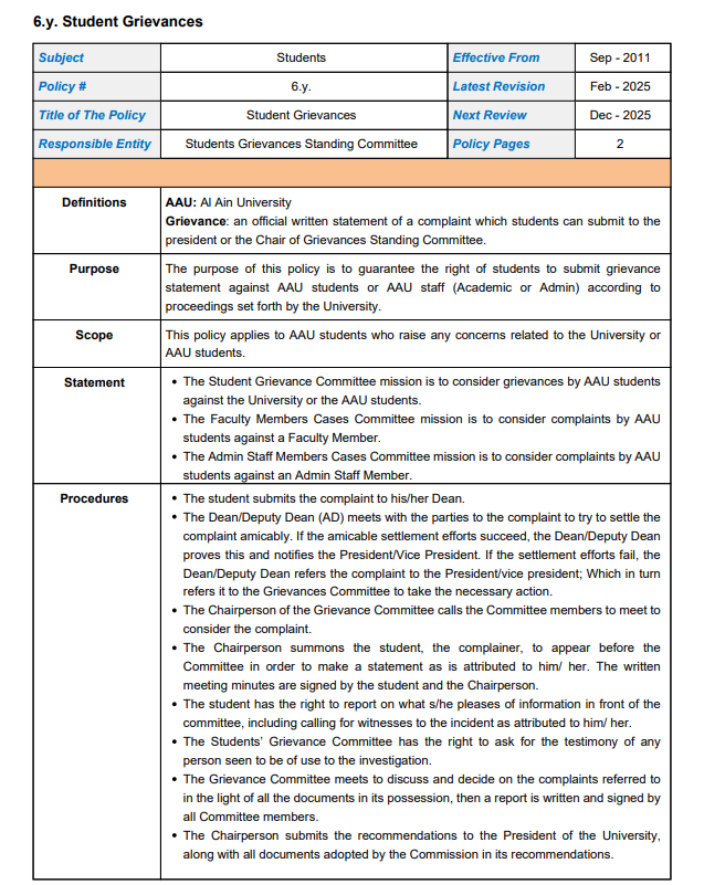
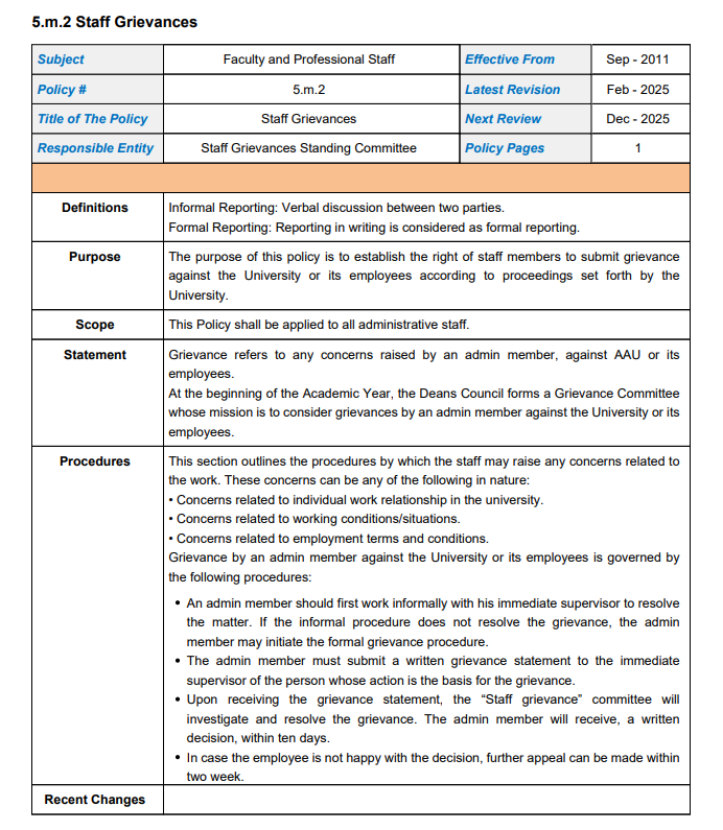
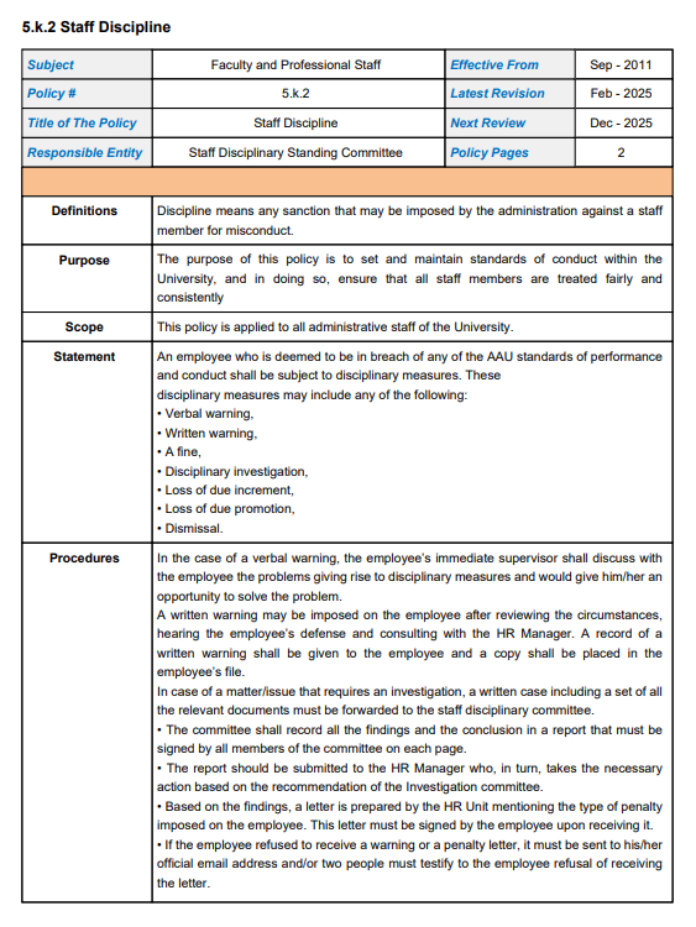
FORMAL POLICY ARCHITECTURE
2. The Non-Discrimination Policy defines protection, scope and remedy
The policy's purpose is to provide a safe environment in which people are treated fairly and equally. Its institutional statement affirms respect and equality and rejects discriminatory or prejudicial treatment of students, faculty, administrative staff and other stakeholders. Harassment is treated within this non-discrimination framework, and members of the University community are encouraged to report discrimination they experience or witness through the applicable grievance procedures.
Policy component | Institutional provision | Operational effect |
Purpose | Safe working and learning environment; fair and equal treatment | Inclusive access and participation are institutional expectations |
Scope | Employees and students, with the policy statement covering faculty, administrative staff and other stakeholders | Protection reaches the principal groups delivering and using AAU activities |
Protected grounds | Gender, marital status, ethnicity or nationality, age, religion, disability or special needs | Explicit protection for the characteristics central to THE 4.3.5 |
Prohibited conduct | Discrimination, prejudicial treatment and harassment are not tolerated | Access cannot be restricted by discriminatory treatment |
Reporting | Experienced or witnessed concerns may be raised through grievance procedures | Both affected persons and witnesses can activate review |
Institutional responsibility | University governance, Human Resources, academic and administrative management | Implementation is embedded in decision-making and employment practice |
Public evidence: E04 | E05 | E06
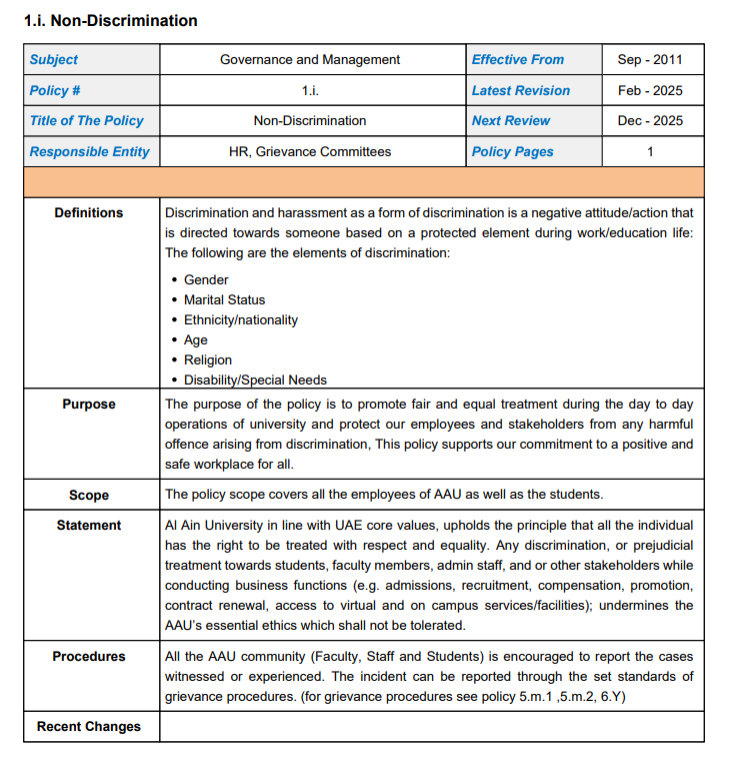
POLICY EFFECT
AAU rejects discrimination in access, participation, employment and treatment. The same standard applies before an activity begins, while it is delivered and when a complaint or support need is raised.
EQUITY, DIVERSITY AND PROTECTED CHARACTERISTICS
3. AAU protects diversity across identity, background and circumstance
AAU's Non-Discrimination Policy expressly protects gender, marital status, ethnicity or nationality, age, religion, disability and special needs. The University's diversity statement broadens the operating culture: diversity is fundamental to academic excellence; different backgrounds and perspectives enrich the educational experience; and faculty and students from all backgrounds and origins should interact in a welcoming, respectful setting with access to education for all.
Characteristic | AAU policy basis | Inclusive-access application | Supporting evidence |
Ethnicity, nationality, race and colour | Ethnicity or nationality is explicit; AAU diversity covers all backgrounds and origins; QAA records race-neutral recruitment | Equal invitation, admission, participation and employment treatment | Policy, diversity page and QAA review |
Religion or belief | Religion is an express protected ground | No faith-based restriction on access to learning and public activities | Policy, handbooks and tolerance initiatives |
Gender and marital status | Both are expressly protected | Equal opportunity in participation, employment, training, research and leadership | Policy, recruitment and women's leadership activity |
Disability, special needs and learning support | Disability or special needs is express; dedicated support and accessible facilities are published | Reasonable access, guidance, accommodation and referral | Support Office, facilities and inclusion programmes |
Age | Age is an express protected ground | Access encompasses school pupils, adult learners, staff and community members | Policy and SDG 4.3 delivery portfolio |
Social or economic background and class | All-backgrounds commitment, grants and financial-aid arrangements reduce access barriers | Participation is supported where financial or social circumstances could restrict opportunity | Diversity and financial-aid policies |
Public evidence: E04 | E07 | E13 | E30 | E41 | E46 | E48
Diversity in the University
https://aau.ac.ae/en/about-aau/diversity
AAU strongly believes diversity to be fundamental to academic excellence as the values of equal opportunity to access education are deeply-rooted in the UAE diverse community. Experience has shown that the more varied the backgrounds and perspectives of students and faculty, the richer the academic experience becomes.
For faculty and professional staff, diversity reinforces ties in the workplace leading to the ultimate success and realization of goals. Similarly, for students, learning in a diverse educational environment affords students the opportunity for personal growth, instills the values of mutual respect, and builds the spirit of teamwork leading to a generation of professionals who will be able to help build a closely-knit community.
Moreover, working towards the future requires raising a generation of professionals who are able to work in a diverse, pluralistic workplace, and who deal with others on the basis of contribution and character. To that end, AAU strives to create a healthy diverse atmosphere where students and faculty from all backgrounds and origins can positively interact and effectively contribute to the exchange of information and the flow of knowledge in a way that assists each and every one of them in the pursuit of their goals hence contributing to achieving the mission of AAU.
At AAU’s diverse learning environment, faculty and students come together in a welcoming and respectful setting that allows access to education for all and offers them the maximum opportunity for a culturally diverse experience.
3.1 Students and staff are covered by complementary instruments
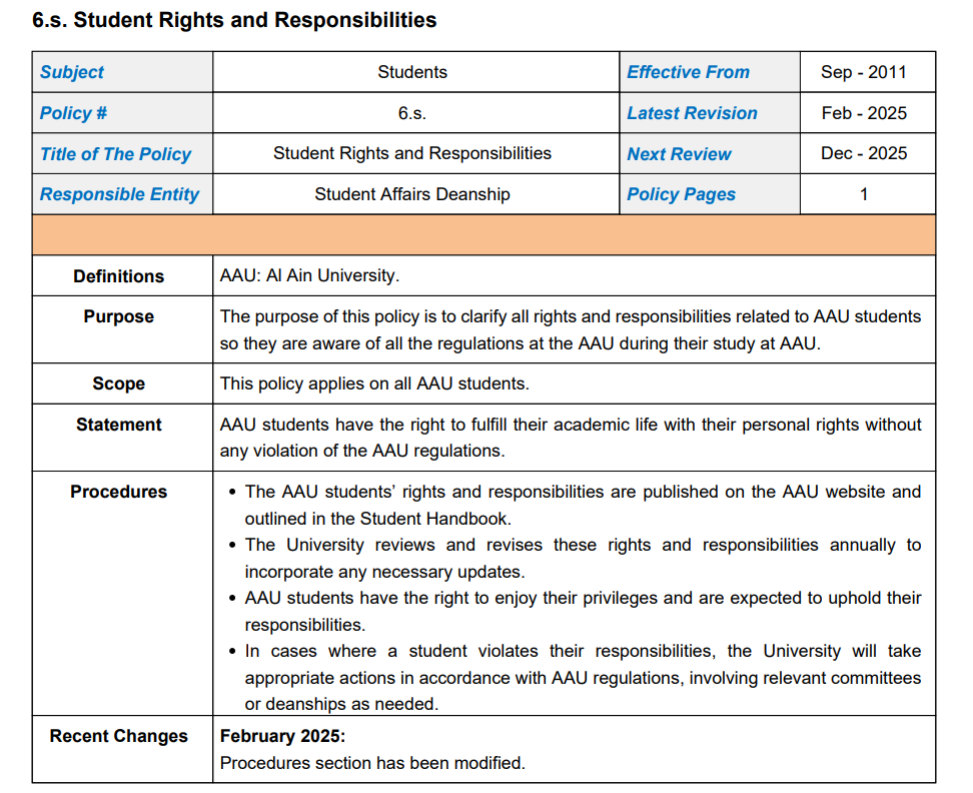
Student rights and responsibilities, student grievance, counselling, health and discipline policies protect learners' participation and provide routes for support and redress. Staff and faculty grievance, discipline, recruitment, professional-development and benefits policies apply the same equal-opportunity principle to employment, progression and professional life. Current 2024-2025 and 2025-2026 handbooks make the framework accessible to both communities.
Public evidence: E09 | E10 | E11 | E12 | E13 | E14 | E18 | E19 | E21 | E24
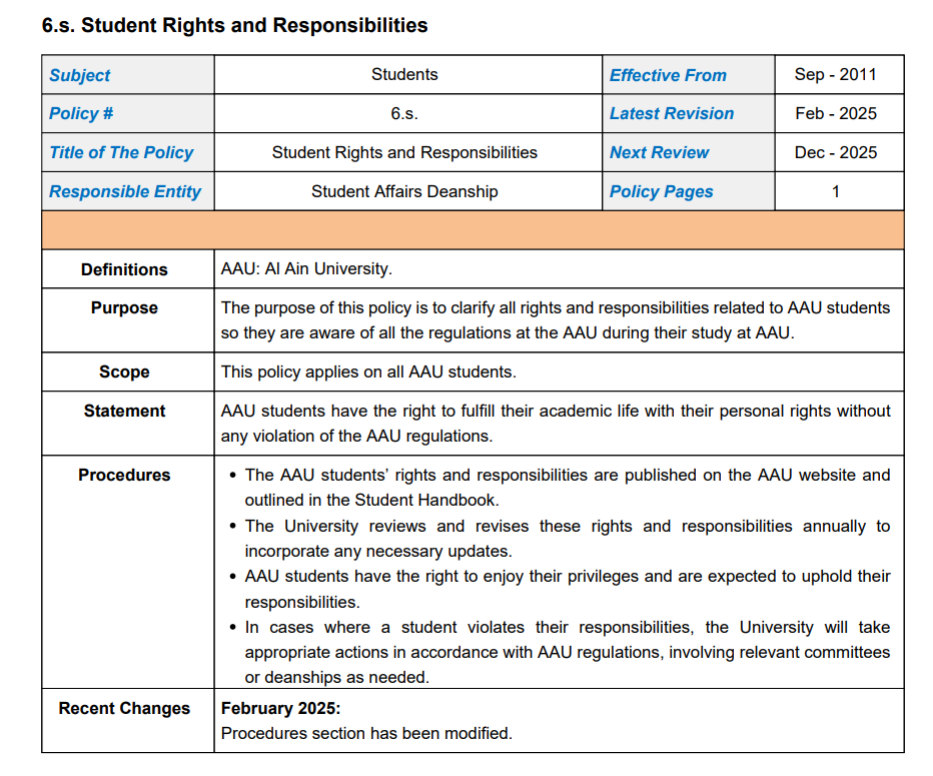
Code of Conduct
https://aau.ac.ae/uploads/2019/09/al_ain_university_student_handbook_2019_2020_en.pdf
The statements hereunder define some areas of ethical conduct that govern AAU members’ behavior towards their peers, faculty members, the University, and the community. These statements do not address every situation; rather, they aim at providing the student with an overview of a general perspective on the code of ethics governing Al Ain University.
17.1 Compliance with AAU’s Rules and Regulations
All students at AAU shall abide by the rules and regulations applicable at AAU. If the student is uncertain about any issue, s/he may refer to the HR Manager, the Department Head, the College Dean, AAU Vice President, or AAU President.
Harassment or Discrimination
Al Ain University upholds the principle that all individuals have the right to be treated with respect and equality. Any harassment, discrimination, or prejudicial treatment towards peers, faculty members, or administrative staff on grounds of ethnicity, religion, national origin, gender, age, or disability status undermines the AAU’s essential ethics and shall not be tolerated.
EQUAL ACCESS TO SDG 4.3 ACTIVITY
4. The policy governs participation in resources, events, training and outreach
AAU's equality framework is University-wide and therefore governs how the lifelong-learning and public-engagement activities reported under SDG 4.3 are offered. Inclusive access covers communication and invitation, registration or admission, physical and digital participation, use of facilities, access to information and guidance, and the response to any concern raised by a participant.
SDG 4.3 activity | Equal-access commitment | Delivery controls | Protected participants |
Educational resources (4.3.1) | Fair access to knowledge, library, digital resources, lectures and facilities | Published services, guidance, disability support and grievance routes | Researchers, visitors, school pupils and other non-enrolled users |
Public lectures and community events (4.3.2) | Open participation without discrimination | Public communication, accessible venues, respectful conduct and support | Community members of different identities, faiths, ages and abilities |
Executive education and vocational training (4.3.3) | Equal access to short, non-degree learning and professional development | Transparent course information, delivery support and fair treatment | Graduates, professionals, organisations and adult learners |
Beyond-campus outreach (4.3.4) | Inclusive participation where AAU delivers in schools and community settings | Partner coordination, supervised activity and University conduct requirements | School pupils, families, civil-society groups and the public |
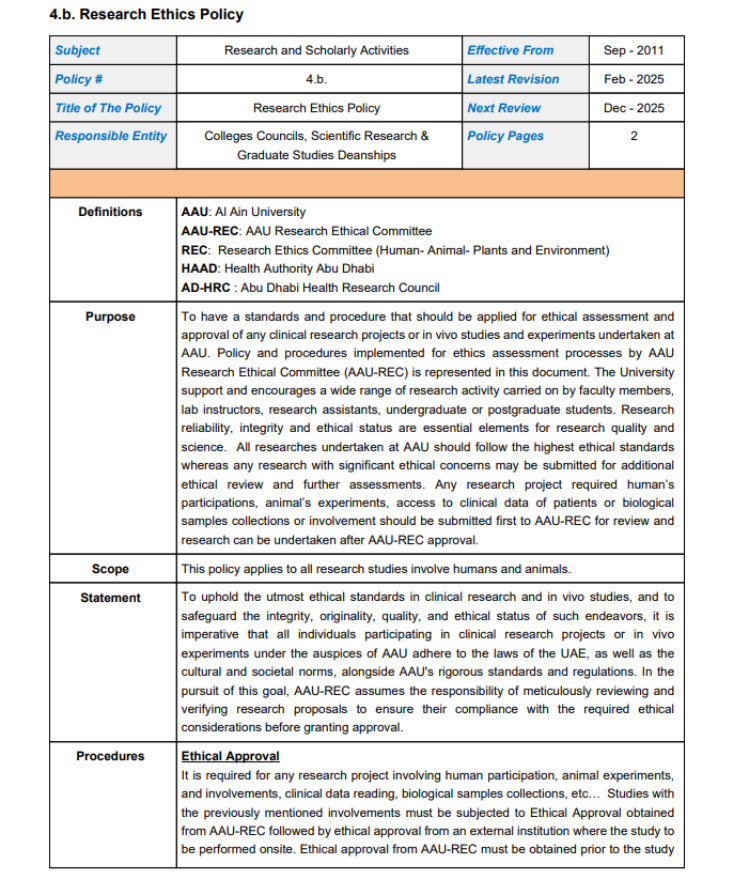
Research, extension and volunteering | Equal opportunity to contribute, lead, learn and receive recognition | Research ethics, academic freedom, research support and student governance | Students, researchers, staff, volunteers and partners |
Public evidence: E02 | E03 | E04 | E07 | E13 | E26 | E28 | E29 | E31
4.1 Equal opportunity across the academic community
The framework protects opportunity in training, research, community extension, professional activity, employment, academic work and administrative management. It supports entry, continued participation, progression and access to institutional support, rather than limiting equality to admissions alone.
Public evidence: E21 | E24 | E26 | E27 | E28 | E29
DISABILITY INCLUSION AND REASONABLE ACCESS
5. Policy protection is reinforced by dedicated people, facilities and practice
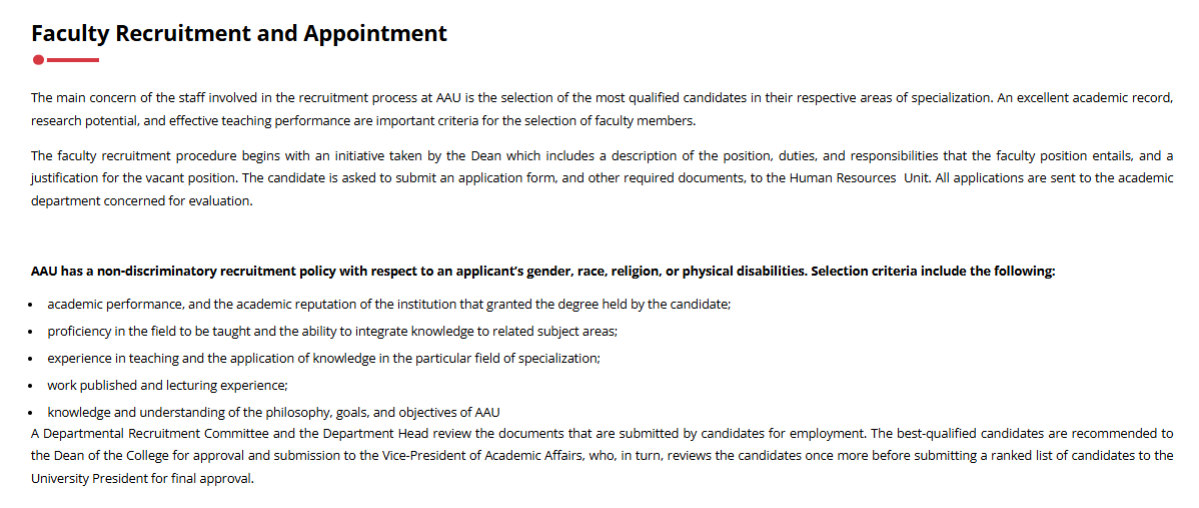
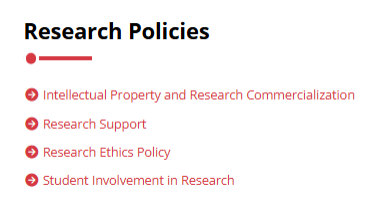
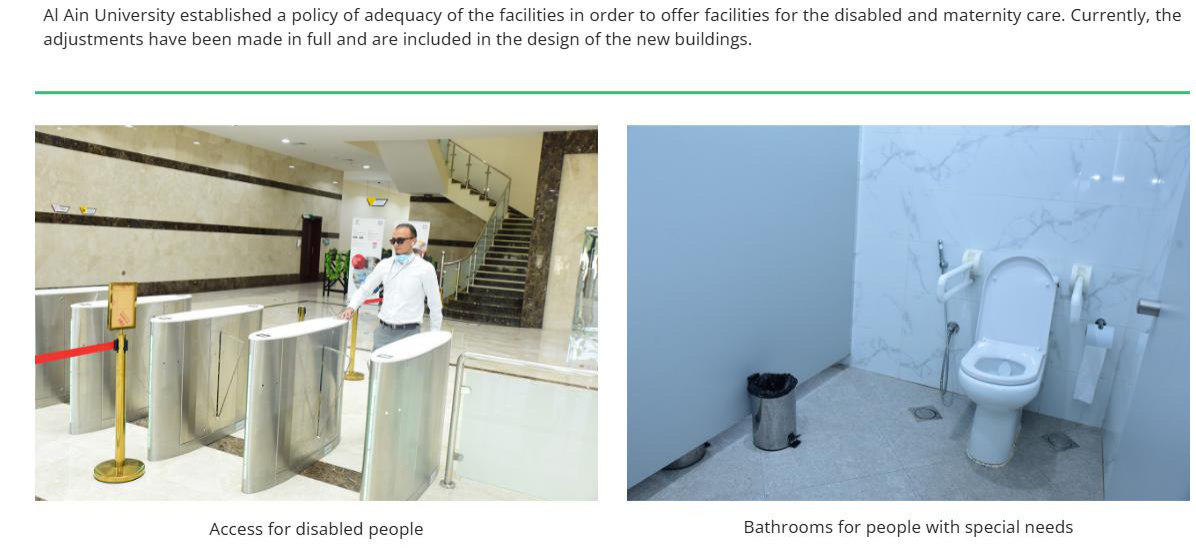
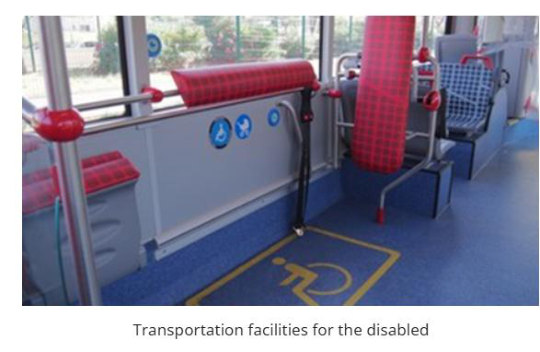
Disability and special needs are explicit protected grounds. AAU reinforces the policy through a People of Determination Support Office and public evidence on accessible campus facilities. The facilities record identifies disabled access, accessible bathrooms and transportation, together with maternity-care, nursery and kindergarten provision. These arrangements support physical participation and help students, staff and visitors manage disability, caregiving and family responsibilities.
Access layer | AAU provision | Barrier addressed | Public evidence |
Policy | Express protection for disability or special needs | Discriminatory exclusion or prejudicial treatment | Non-Discrimination Policy |
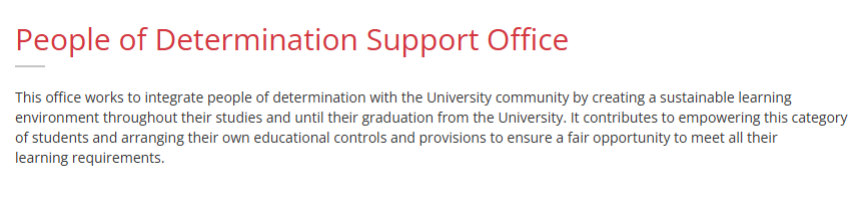
Specialist support | People of Determination Support Office | Need for coordinated guidance, accommodation and liaison | Published Student Affairs service |
Physical access | Accessible routes, bathrooms and transport | Mobility and facility barriers | AAU campus-facilities evidence |
Family and maternity support | Maternity-care facilities, diaper changing, nursery and kindergarten | Caregiving and family-life barriers | AAU campus-facilities evidence |
Awareness and capability | Etiquette and sports workshops and external training activity | Knowledge, confidence and inclusive practice | Dated 2024 implementation |
Public evidence: E04 | E31 | E32 | E33 | E34
Campus facilities for disable and maternity care
5.1 Dated 2024 implementation
In 2024 AAU's College of Engineering participated in training for students of Zayed Higher Organization for People of Determination. AAU also documented a workshop on etiquette for dealing with people of determination and student participation in a workshop on sports for people of determination. These activities show that inclusion is implemented through learning, staff and student capability, community partnership and practical participation.
Public evidence: E35 | E36 | E37
CoE Participates in Training Program for Students of ZHO for People of Determination
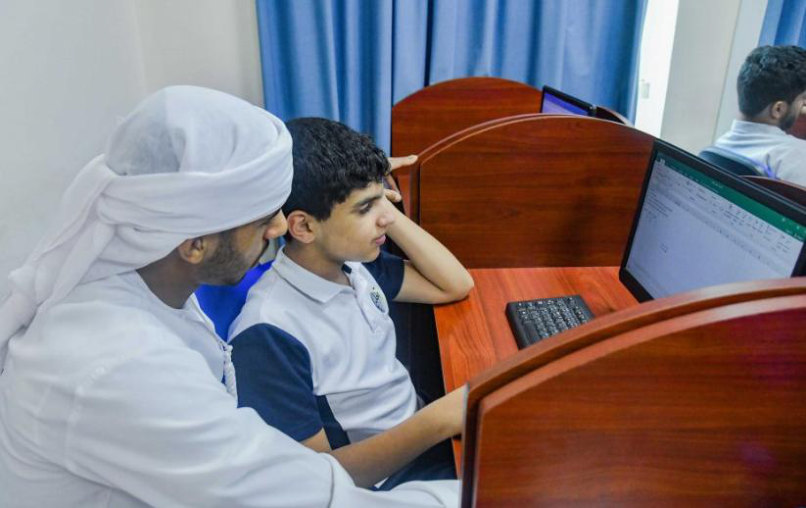
For the second consecutive year, Al Ain University, represented by its College of Engineering at both its Abu Dhabi and Al Ain campuses, participates in the training program for students of the Zayed Higher Organization for People of Determination. The training aims to prepare students to participate in the "Global IT Challenge for Youth with Disabilities 2024" competition, which will be held in the Philippines. This program is part of Al Ain University's efforts to support and empower people of determination in the field of information technology and digital sciences.
The role of the College of Engineering includes providing laboratories for training and exams, in addition to training students in various fields such as creating and editing presentations using PowerPoint, handling data using Excel, learning research skills using the internet, making and editing videos, Internet of Things projects, and programming self-driving cars. The number of students was 19 at the Abu Dhabi campus and 11 at the Al Ain campus.
Engineering students at the Abu Dhabi campus participated in the different aspects of the training program, including students Mohammad Khafash and Omar Al Kendi, under the supervision of laboratory engineers, enhancing the diversity and richness of the training experiences offered to the students. The training phase lasts for five months, ending at the end of October this year.
It is worth noting that the UAE team won first place in the Internet of Things Challenge for the year 2023, with the participation of a student from the College of Engineering among the people of determination.
A training workshop entitled “Etiquette for Dealing with People of Determination”
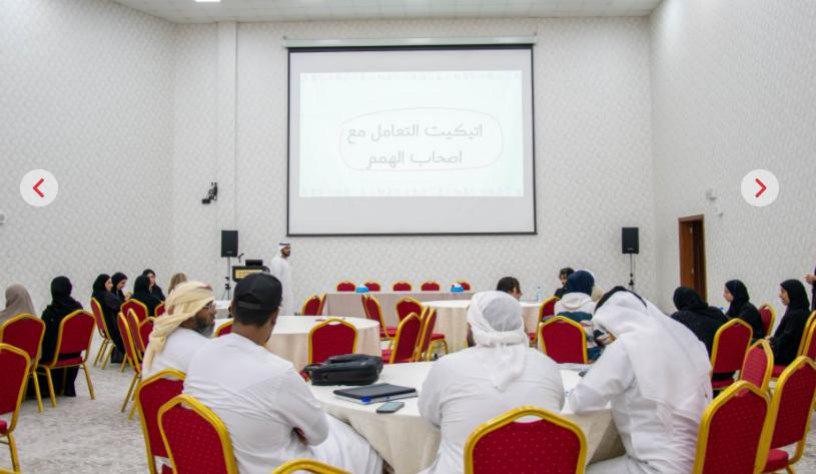
The Deanship of Student Affairs at Al Ain University (Abu Dhabi headquarters) organized a training workshop entitled “Etiquette for Dealing with People of Determination,” presented by the professor. Amin Al-Attas - Psychologist and certified trainer.
The workshop included a detailed explanation of the concept and definition of disability, an explanation of the different types of disabilities, including auditory, visual, motor, and sensory disabilities, and how to deal with the different categories of disabilities correctly, such as not looking at them for a long time in a staring manner to avoid embarrassing them, meeting them with a smile when dealing with them, and not showing any strange reaction. When seeing them and other correct behaviors when dealing with people of determination.
The workshop aimed to enhance awareness and understanding of how to deal correctly and professionally with people of determination, which had a positive impact on students and further strengthened understanding and respect towards people of determination, increasing students’ awareness and motivating them to interact positively and building bridges of communication with people of determination and all members of society in various areas of life.
EQUAL OPPORTUNITY IN ACADEMIC AND PROFESSIONAL LIFE
6. Recruitment, development, research and management follow equal-opportunity controls
AAU applies non-discrimination to the academic and administrative workforce through faculty recruitment and appointment, staff policy, professional-development, research-support, academic-freedom and research-ethics instruments. Human Resources guidance requires those involved in recruitment and promotion to observe the Non-Discrimination Policy. Opportunities are therefore governed by qualification, role requirements and institutional criteria rather than protected characteristics.
Opportunity area | AAU framework | Equality effect | Independent/public confirmation |
Recruitment and appointment | Non-discrimination and faculty recruitment controls | Clear, fair and qualification-based selection | QAA records equal-opportunity recruitment regardless of gender, race, religion or physical disability |
Promotion and management | HR implementation and published staff policies | Policy applies to employment decisions and academic or administrative progression | QAA records HR guidance to recruitment and promotion decision-makers |
Training and professional development | Professional Development Centre and policy | Staff at different grades, roles and locations can access appropriate development | QAA records face-to-face, online, customised and funded development |
Research and extension | Research support, ethics and academic freedom | Fair access to research participation, support and responsible knowledge exchange | Public research policy architecture |
Work, family and academic life | Benefits, flexible service delivery and family-supporting facilities | Participation is supported across work, study and caregiving responsibilities | Handbooks, benefits and maternity/nursery facilities |
Public evidence: E04 | E11 | E12 | E21 | E22 | E24 | E25 | E26 | E28 | E29 | E32 | E41
EQUAL OPPORTUNITY ACROSS THE EMPLOYEE LIFECYCLE
The framework covers recruitment, appointment, promotion, development, research, academic freedom, management participation, grievance and discipline. It therefore protects both entry to AAU and continued opportunity within the institution.
HARASSMENT AND GENDER-BASED VIOLENCE
7. AAU provides reporting, care, monitoring, referral and accountability routes
AAU addresses gender-based harassment and violence through its broader non-discrimination, grievance, counselling, health and discipline framework. Gender is an express protected ground, harassment is not tolerated, and students and employees can report concerns through dedicated grievance procedures. The pathway applies when conduct connected with University study, work, services or authorised activity affects a member of the AAU community, including concerns communicated through institutional physical or digital channels.
Safeguarding function | Institutional route | Response provided | Relevant groups |
Prevention | Non-Discrimination Policy, handbooks, rights and responsibilities | Clear prohibition, standards of respectful conduct and awareness | Students, faculty, staff and other stakeholders |
Reporting | Student, staff and faculty grievance procedures | Documented route to raise experienced or witnessed conduct | Affected persons and witnesses |
Immediate care | Student counselling and health services | Confidential support within professional service boundaries and assessment of needs | Students requiring academic, social, psychological or health support |
Monitoring and review | Responsible administrative or academic authority under grievance procedure | Receipt, review, documentation, communication and follow-up | Complainant, respondent and relevant decision-makers |
Referral and escalation | Counselling, health and institutional management routes | Referral to specialised internal or external support where required | Persons needing clinical, protective or specialised assistance |
Accountability | Student and staff discipline procedures | Proportionate institutional action where misconduct is established | Students and employees |
Public evidence: E04 | E09 | E10 | E11 | E12 | E13 | E14 | E15 | E16 | E17 | E18 | E19 | E20
7.1 Awareness and specialist partnership
AAU's public record includes a partnership activity with the Dubai Foundation for Women and Children addressing violence and a 2025 awareness workshop on human trafficking delivered with the Family Care Authority. These initiatives reinforce prevention, rights awareness and knowledge of specialist protection systems beyond the internal case-management route.
Public evidence: E45 | E52 HUMAN RIGHTS, DIGNITY AND INSTITUTIONAL CULTURE
8. AAU rejects discrimination and promotes respect, tolerance and participation
AAU's policy commitment is grounded in respect for human dignity, equality and the right to participate in education. It aligns with the UAE's official anti-discrimination and human-rights framework and with national protection of the rights of people of determination. AAU's diversity statement and student and staff instruments translate these principles into the daily learning and working environment.
2024 implementation | Equality dimension | Institutional meaning | Evidence |
International Day for Tolerance student panorama | Religion, culture and mutual respect | Students publicly affirm love, humanity and coexistence | AAU event record |
Student participation promoting tolerance | Belonging and non-discrimination | Values are carried into community-facing participation | AAU event record |
Tolerance Clubs orientation | Sustained student organisation | Tolerance is supported through a repeatable student-engagement mechanism | AAU event record |
AAU and Burjeel Hospital celebrate Emirati women | Gender equality and recognition | Women's contribution and participation are institutionally visible | AAU event record |
Student Council discussions | Voice and participation | Students have a representative forum for issues and initiatives | AAU event record |
Research presented by students from eight Arab countries | Nationality and cultural diversity | Academic participation crosses national backgrounds | AAU event record |
People of Determination workshops and training | Disability inclusion | Policy is reinforced through capability and practical engagement | AAU 2024 records |
Public evidence: E07 | E31 | E35 | E36 | E37 | E38 | E39 | E40 | E42 | E43 | E44 | E46 | E47 | E48
HUMAN-RIGHTS STANDARD
AAU respects the dignity and rights of its students, staff and stakeholders; rejects discrimination and harassment; enables participation and voice; and maintains routes for support and redress.
INDEPENDENT EXTERNAL CORROBORATION
9. QAA's 2024 International Quality Review confirms policy implementation
The Quality Assurance Agency for Higher Education conducted an International Quality Review of AAU from 12 to 14 February 2024 and found that AAU met all ten applicable European Standards and Guidelines. The published review independently records AAU's Non-Discrimination Policy and Human Resources guidance requiring staff involved in recruitment and promotion to observe it.
QAA also records clear, transparent and fair recruitment; equal-opportunity selection without discrimination on grounds including gender, race, religion or physical disability; extensive professional-development provision; counselling that covers academic, career, pastoral and crisis needs; and learning resources and support that are readily accessible and equitably provided across both campuses. Flexible morning, evening and weekend scheduling and evening counselling availability support students with differing circumstances and responsibilities.
QAA finding | Independent confirmation | Relevance to inclusive access |
Non-discrimination | AAU has a formal policy and HR provides implementation guidance | Policy is applied in recruitment and promotion decisions |
Fair recruitment | Processes are clear, transparent, fair and equal-opportunity based | Gender, race, religion and physical disability do not determine selection |
Professional development | Face-to-face, online, customised and funded development is available | Different roles, locations and learning needs are supported |
Student support | Academic, career, pastoral and crisis counselling is provided | Students with differing personal circumstances can obtain support |
Equitable delivery | Resources and services are available across both campuses, with flexible scheduling | Location, timing and individual circumstances are addressed |
Public evidence: E04 | E21 | E24 | E31 | E41
9.1 Demonstrated diversity
QAA reported a 2023-2024 student population of 1,663, comprising 28% Emirati, 34% from other Gulf Cooperation Council countries and 38% international students. It also reported 209 full-time faculty members, with more than three quarters drawn from Jordan, Egypt, Canada and Pakistan, and a faculty gender profile of 65% men and 35% women. These data evidence a genuinely multinational University community operating under the published equality framework.
Public evidence: E41 CURRENT INSTITUTIONAL CONTINUITY
10. Inclusive access remains active in 2025-2026
AAU's public record after the 2024 core evidence year confirms continued gender empowerment, cultural diversity, disability inclusion, safeguarding awareness and tolerance activity. The policy is therefore accompanied by ongoing institutional practice rather than presented as a historical document only.
Year | Current public evidence | Equality or inclusion outcome | Policy continuity |
2025 | Empowering Women, Building Futures | Women's empowerment and future participation | Gender equality remains visible in programming |
2025 | Industry Business Day and Women Leadership Forum | Professional leadership and opportunity | Gender inclusion extends to careers and leadership |
2025 | Russia in the Heart of AAU | Cultural exchange and appreciation | Diversity of nationality and background is celebrated |
2025 | Human-trafficking awareness with Family Care Authority | Rights, prevention and specialist safeguarding awareness | Protection activity complements grievance and support routes |
2025 | Lecture on inclusion of people of determination | Awareness of inclusive participation | Disability inclusion remains an active learning priority |
2025 | Innovation for Inclusion with National Multiple Sclerosis Society | Partnership-based inclusion and innovation | External collaboration strengthens access |
2026 | MoU with Al Ain Training and Rehabilitation Center | Training, rehabilitation and community inclusion | Formal partnership extends disability support |
2026 | Our Life in the UAE forum | Belonging, tolerance and coexistence | Respect and non-discrimination remain student-facing values |
Public evidence: E49 | E50 | E51 | E52 | E53 | E54 | E55 | E56 INSTITUTIONAL CONCLUSION
11. AAU meets THE Indicator 4.3.5
Al Ain University has a formal, publicly accessible and institution-wide policy framework that ensures access to educational resources, public events, executive education, vocational training and educational outreach without discrimination. The Non-Discrimination Policy expressly protects gender, marital status, ethnicity or nationality, age, religion, disability and special needs; the University's diversity commitment covers people from all backgrounds and origins; and the wider legal and institutional framework addresses race, colour, social circumstance and equal human dignity.
The policy applies to students and employees and extends AAU's non-tolerance standard to faculty, administrative staff and other stakeholders. It is implemented through rights and responsibilities, grievance, counselling, health, discipline, recruitment, professional-development, research, accessibility and financial-aid arrangements. These controls provide equal opportunity across training, research, community extension, professional activity, employment, academic and administrative management, while facilities and flexible services support work, family and academic life.
AAU also provides a complete institutional pathway for gender-based harassment and violence: prevention and prohibition; reporting by affected persons or witnesses; counselling and health support; administrative monitoring and review; referral or escalation where specialist assistance is required; and discipline where misconduct is established. Dated 2024 implementation, current 2025-2026 activity and QAA's independent 2024 findings confirm that the policy operates in practice.
FINAL RESPONSE: YES
AAU ensures that access to its SDG 4.3 activities is available to all without discrimination on grounds of ethnicity or nationality, race or colour, religion, gender, marital status, age, disability or special needs, or social background. The commitment is formal, public, implemented through accountable procedures and independently corroborated.
11.1 Submission evidence summary
THE evidence theme | AAU evidence | Institutional result |
Formal policy and protected characteristics | Published Non-Discrimination Policy, explicit protected grounds and all-backgrounds diversity commitment | Institution-wide accountability and access irrespective of identity, belief, gender or disability |
Students, staff and academic opportunity | Handbooks, rights, recruitment, development, research, grievance and discipline | Equal treatment across study, employment, training, research and management |
Disability access and safeguarding | Dedicated Support Office, accessible facilities, counselling, health, reporting, referral and discipline | Reasonable access plus a complete response to harassment and gender-based violence |
Independent verification and continuity | QAA International Quality Review 2024 and current 2025-2026 implementation | Policy and equitable practice externally corroborated and currently active |
Public evidence: E02 | E04 | E07 | E13 | E14 | E18 | E21 | E24 | E31 | E32 | E41 PUBLIC EVIDENCE
12. Evidence register
The following public sources support the policy, protected characteristics, institutional scope, equal-access controls, disability inclusion, safeguarding pathway, 2024 implementation, external corroboration and current continuity presented in this submission.
ID | Year/type | Public source | Evidence supported |
E01 | THE 2026 | Indicator definition and evidence requirement | |
E02 | AAU SDG | Public institutional SDG 4.3.5 evidence page | |
E03 | AAU SDG | Downloadable public institutional evidence document | |
E04 | AAU policy | Core Non-Discrimination Policy, protected grounds and reporting | |
E05 | AAU current | Public University Policies index | |
E06 | AAU policy | Consolidated University policy architecture | |
E07 | AAU current | Diversity, all backgrounds and access to education for all | |
E08 | AAU current | Public Policies and Procedures index | |
E09 | AAU 2024-25 | Current reporting-year Student Handbook | |
E10 | AAU 2025-26 | Current Student Handbook and policy continuity | |
E11 | AAU 2024-25 | Current reporting-year Staff Handbook | |
E12 | AAU 2025-26 | Current Staff Handbook and policy continuity | |
E13 | AAU policy | Student rights, responsibilities and respectful participation | |
E14 | AAU policy | Student reporting and grievance route |
PUBLIC EVIDENCE CONTINUED
12.1 Support, employment, research and accessibility
ID | Year/type | Public source | Evidence supported |
E15 | AAU policy | Student counselling, care and referral route | |
E16 | AAU policy | Health support and referral route | |
E17 | AAU policy | Student discipline and accountability | |
E18 | AAU policy | Staff grievance and reporting route | |
E19 | AAU policy | Faculty grievance and reporting route | |
E20 | AAU policy | Staff discipline and accountability | |
E21 | AAU policy | Fair faculty recruitment and appointment | |
E22 | AAU current | Public staff-policy architecture | |
E23 | AAU current | Public student-policy architecture | |
E24 | AAU policy | Equitable professional-development opportunity | |
E25 | AAU policy | Benefits supporting employment participation | |
E26 | AAU policy | Research support and opportunity | |
E27 | AAU current | Public research-policy architecture | |
E28 | AAU policy | Academic freedom and academic participation |
PUBLIC EVIDENCE CONTINUED
12.2 Inclusion, implementation and independent review
ID | Year/type | Public source | Evidence supported |
E29 | AAU policy | Research ethics and responsible participation | |
E30 | AAU policy | Financial-aid route reducing economic barriers | |
E31 | AAU current | Dedicated People of Determination Support Office | |
E32 | AAU current | AAU facilities for disability, special needs and maternity care | Accessible and family-supporting campus facilities |
E33 | AAU SDG | Public disability-access evidence | |
E34 | AAU SDG | Public disability-support evidence | |
E35 | AAU 2024 | External training involving people of determination | |
E36 | AAU 2024 | Etiquette for Dealing with People of Determination workshop - 2024 | Inclusive-practice etiquette workshop |
E37 | AAU 2024 | Sports inclusion workshop | |
E38 | AAU 2024 | International Day for Tolerance student activity | |
E39 | AAU 2024 | Student participation promoting tolerance | |
E40 | AAU 2024 | Tolerance Clubs orientation and sustainability | |
E41 | Independent 2024 | QAA International Quality Review of Al Ain University - February 2024 | QAA confirmation of policy and equitable practice |
E42 | AAU 2024 | Recognition and participation of Emirati women |
PUBLIC EVIDENCE CONTINUED
12.3 Participation, human rights and current continuity
ID | Year/type | Public source | Evidence supported |
E43 | AAU 2024 | AAU Student Council discusses student issues and initiatives - 2024 | Student voice through Student Council |
E44 | AAU 2024 | Students from eight Arab countries present research at AAU - 2024 | Research participation across eight Arab countries |
E45 | AAU partnership | AAU and Dubai Foundation for Women and Children combat violence | Violence-prevention awareness with specialist foundation |
E46 | UAE official | National anti-discrimination framework | |
E47 | UAE official | Rights of people of determination | |
E48 | UAE official | Constitutional human-rights guarantees | |
E49 | AAU 2025 | Women's empowerment and future participation | |
E50 | AAU 2025 | Women in professional leadership | |
E51 | AAU 2025 | Cultural-diversity event | |
E52 | AAU 2025 | Awareness workshop on human trafficking with Family Care Authority - 2025 | Safeguarding awareness with Family Care Authority |
E53 | AAU 2025 | Awareness lecture on inclusion of people of determination - 2025 | Inclusion of people of determination |
E54 | AAU 2025 | Innovation for Inclusion partnership with National Multiple Sclerosis Society - 2025 | Innovation for Inclusion partnership |
E55 | AAU 2026 | AAU MoU with Al Ain Training and Rehabilitation Center - 2026 | Training and rehabilitation partnership |
E56 | AAU 2026 | Belonging, tolerance and coexistence forum |