
SDG 5: GENDER EQUALITY
Al Ain University


Contents
- Women's Access and Completion Tracking
- 1. AAU meets THE Indicator 5.3.1
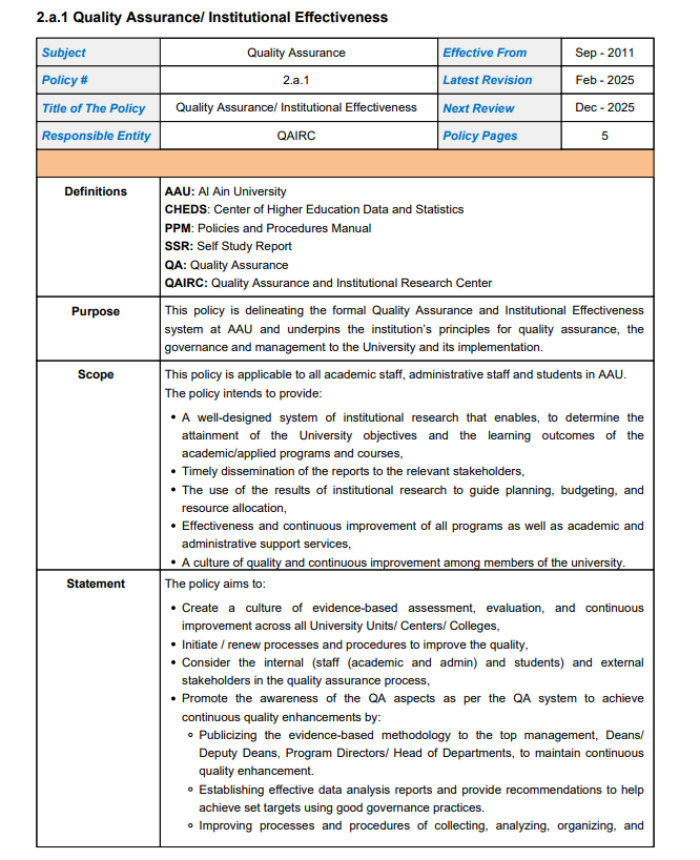
- Quality Assurance/ Institutional Effectiveness
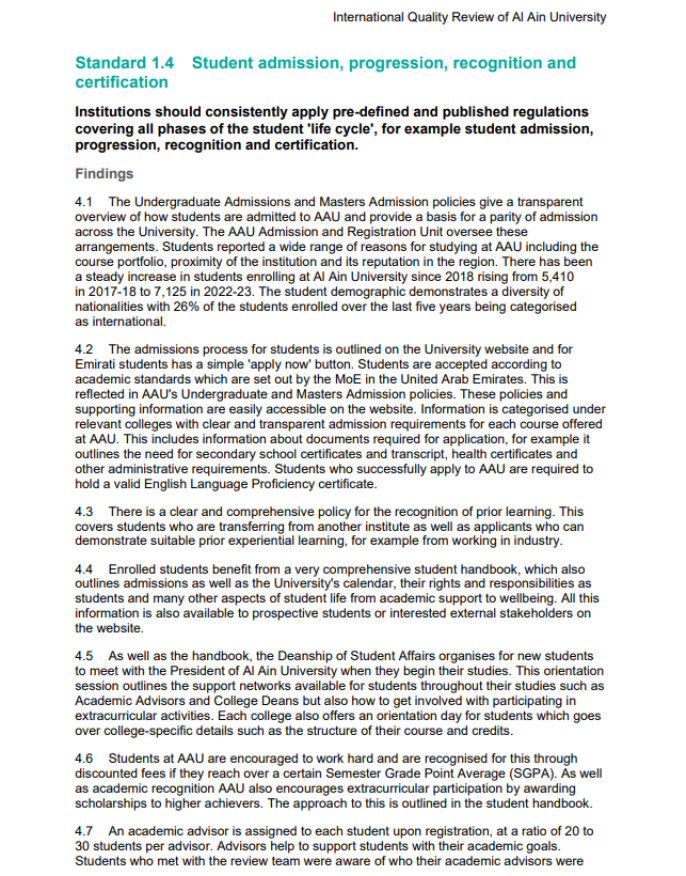
- Student admission, progression, recognition and certification
- 1.1 Evidence-year discipline
- 2. A controlled institutional chain tracks women's access and outcomes
- 3. Named units govern collection, analysis and assurance
- 3.1 Independent confirmation of robust information management
- 4. Women's applications and entry are measurable at source
- 4.1 Public gender-disaggregated output
- Equal Admissions Policy for Both Genders
- Student Rights and Responsibilities
- 5. Study completion is tracked through progression and award records
- 5.1 Public completion evidence and independent review
- 6. The same published standards apply to both genders
- 7. Applicants can see the criteria, mechanism and documents before applying
- 7.1 Public accessibility supports accountability
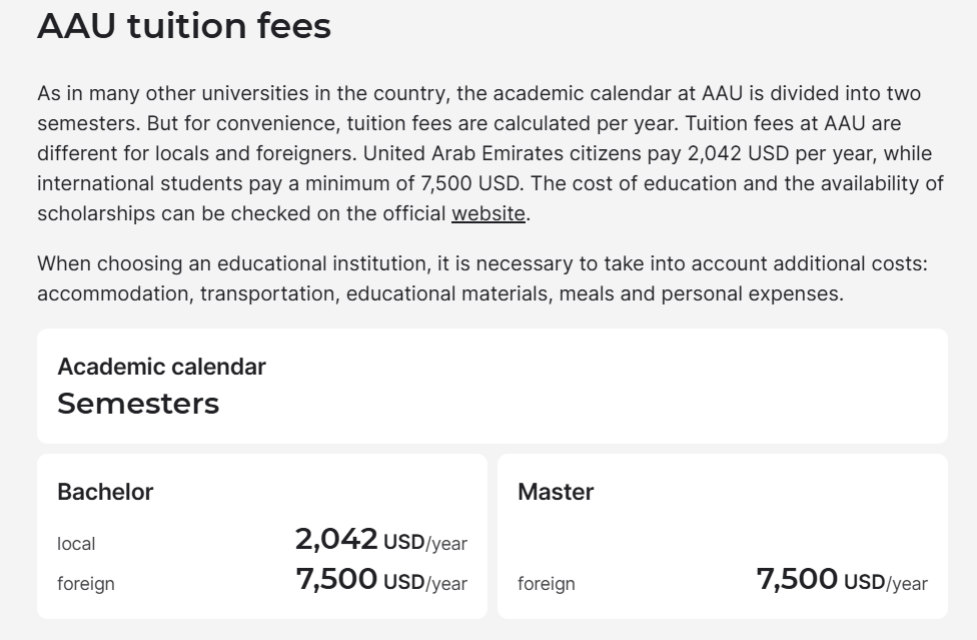
- 8. Entrance charges and study costs are published without gender differentiation
- 8.1 Equal access to financial support
- 9. Dated evidence shows an operating system in the accepted cycle
- 10. Public reporting and guidance remain current
- 10.1 Evidence integrity and defined measures
- 11. AAU systematically tracks women's access and completion
- 11.1 Submission evidence summary
- 12. Evidence register
- 12.1 Policies, quality assurance and records
- 12.2 Application, registration, fees and completion
SUSTAINABLE DEVELOPMENT GOAL 5
Women's Access and Completion Tracking
Application | Acceptance and Entry | Study Completion
DIRECT RESPONSE: YES
Al Ain University systematically measures and tracks women's applications, admission and entry, enrolment, progression and study completion through its Admission and Registration Unit, Banner student-information environment, program and institutional reporting, the Quality Assurance and Institutional Research Center, and externally validated government reporting. Published admission, fee and completion requirements apply to women and men without discrimination.
INSTITUTIONAL RESPONSE
1. AAU meets THE Indicator 5.3.1
THE's 2026 Sustainability Impact Ratings methodology identifies this question as Indicator 5.3.1, Tracking access measures, with 2024 as the evidence year. It asks whether the university systematically measures and tracks women's application rate and acceptance or entry rate. In THE's terminology, the application rate is the ratio of admitted students to total applicants for the academic year; the guidance defines study completion as the proportion of first-time, first-year undergraduates completing within the appropriate timeframe. AAU's institutional systems cover the full pathway from application through admission, entry, progression and award.
THE assessment element | Maximum credit | AAU response | Public proof |
Systematic measurement and tracking | 1.0 | Institution-wide collection, storage, analysis and reporting of admissions and student-lifecycle data | 5.3.1 evidence; QA and reporting system |
Evidence | Up to 1.0 | Specific public institutional sources show responsible units, processes, policies and outputs | AAU policies, reports and SDG evidence |
Public availability | 1.0 | Evidence pages, policies, handbooks, admission criteria, fees and completion rules are publicly accessible | AAU website and publications |
Public evidence: E01 | E02 | E03 | E21 | E22 | E42
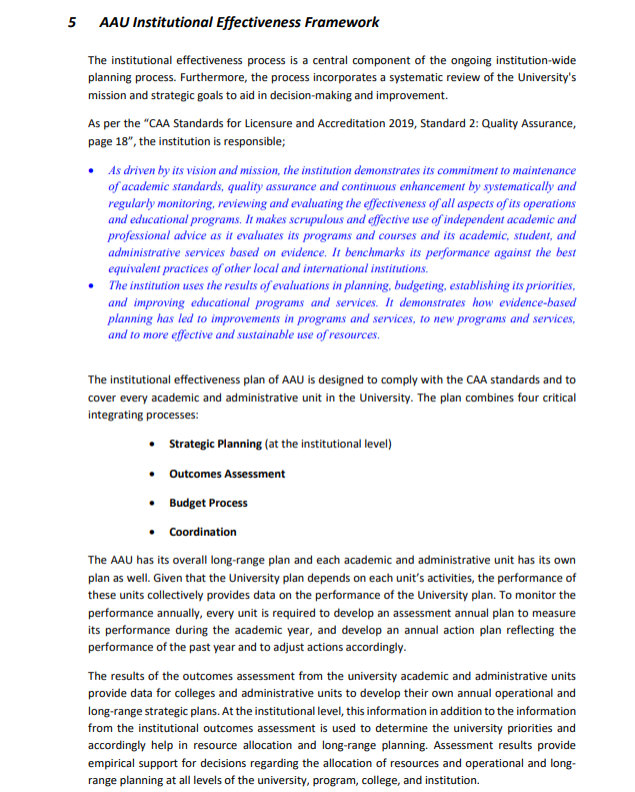
Quality Assurance/ Institutional Effectiveness
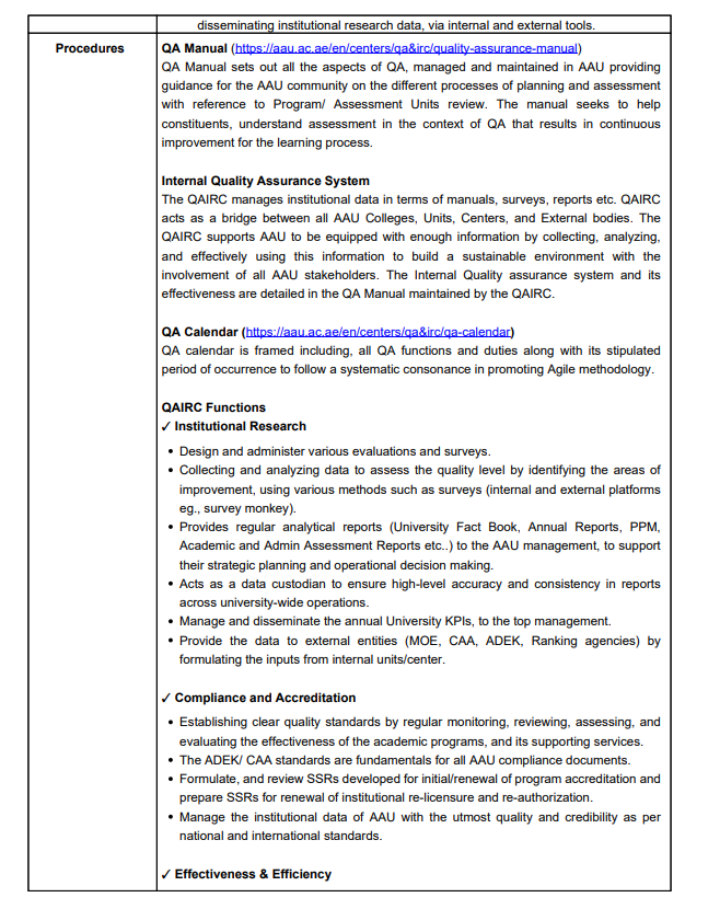
Student admission, progression, recognition and certification
1.1 Evidence-year discipline
The 2024 record is the formal submission foundation: AAU's dedicated 5.3.1 evidence, Annual Report 2023-2024, Quality Assurance Manual dated July 2024, and the independent QAA review issued in February 2024. The Fact Book 2024-2025, Annual Report 2024-2025 and current catalog are used as continuity evidence showing that the measurement and public-guidance framework remains active.
Public evidence: E01 | E02 | E03 | E05 | E06 | E07 | E12 | E22 | E42
SYSTEMATIC MEASUREMENT ARCHITECTURE
2. A controlled institutional chain tracks women's access and outcomes
AAU's evidence demonstrates a repeatable data process rather than a one-time count. Applications enter through published online and administrative channels; Admission and Registration records decisions and entry; student records and Banner maintain the academic lifecycle; colleges and programmes review retention, progression and achievement; QAIRC coordinates institutional analysis and key performance indicators; senior governance reviews results; and official data are reported through regulated national channels. Gender-disaggregated analysis can therefore be produced at each stage.
Lifecycle stage | Responsible mechanism | Tracked record | Institutional use |
Application | Online admission and Admission and Registration Unit | Applicant identity, programme, documents and application status | Application volume and applicant profile |
Acceptance | Published admission criteria and formal decision workflow | Decision, conditions, programme and admission status | Acceptance-rate and parity analysis |
Entry | Registration, student record creation and Banner | New entrant, registered credits and cohort | Entry-rate and cohort baseline |
Progression | Academic records, programme review and advising | Registration, earned credits, standing, retention and progression | Early support and performance monitoring |
Completion | Completion rules, graduation clearance and award record | Qualification, completion date and cohort outcome | Completion-rate and time-to-completion analysis |
Institutional analysis | QAIRC, annual assessment reports and KPIs | Admission, enrolment, retention, progression and achievement datasets | Planning, quality assurance and public reporting |
External validation | CHEDS, Ministry of Education and ADEK reporting | Official institutional performance data | Integrity, compliance and accountability |
Public evidence: E18 | E21 | E22 | E23 | E24 | E29 | E38 | E42
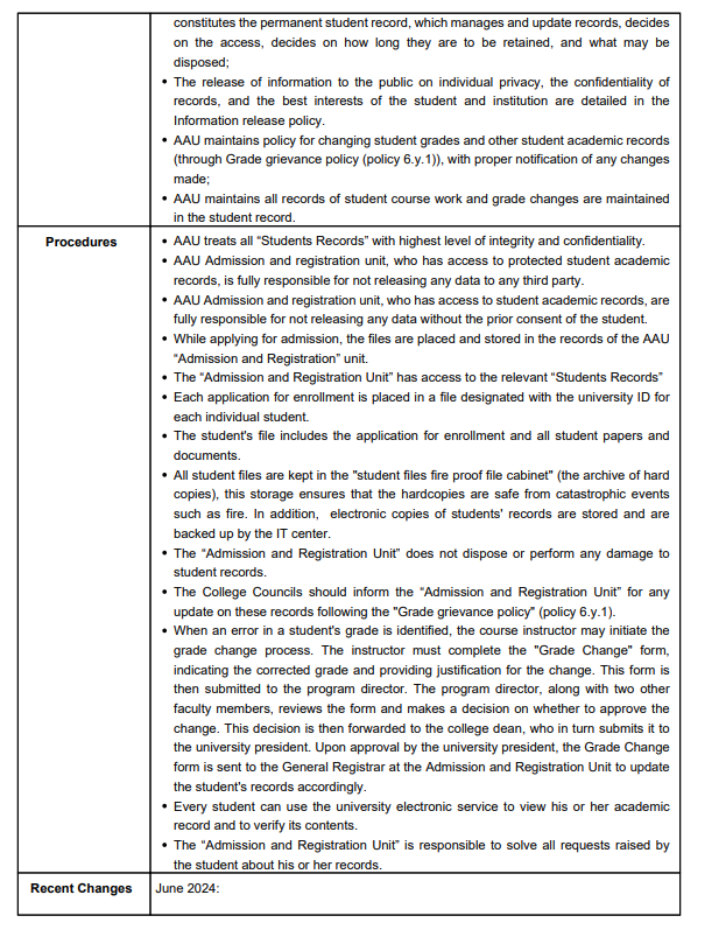
Student Records
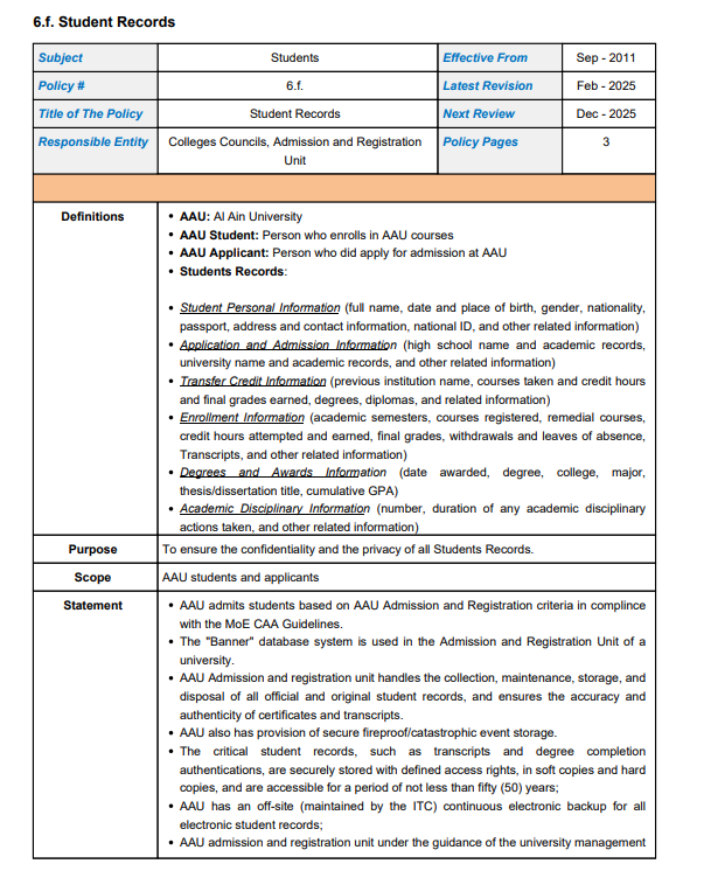
AAU Institutional Effectiveness Framework
Start Your Journey

SYSTEMATIC, NOT AD HOC
The same controlled chain operates for successive cohorts and supports gender-disaggregated calculations for application, acceptance or entry, progression and completion.
GOVERNANCE AND DATA RESPONSIBILITY
3. Named units govern collection, analysis and assurance
Responsibility is distributed but coordinated. The Admission and Registration Unit manages applicant and student administration; academic programmes monitor student performance and completion; QAIRC consolidates institutional research, annual assessment, performance indicators and reporting; University governance reviews plans and results; and national reporting channels independently check official data integrity. Student-record and data-security policies protect the accuracy, confidentiality and authorised use of individual records.
Accountable area | Published responsibility | Contribution to women's tracking |
Admission and Registration Unit | Admission, registration, records, documents, schedules, graduation processing and official student services | Maintains the applicant, entrant and award records required for gender-disaggregated rates |
Academic programmes and colleges | Annual assessment and review of admission, retention, progression, achievement and completion | Interprets cohort outcomes and identifies gaps requiring action |
QAIRC | Institutional research, data analysis, Fact Book, annual reports, KPIs and quality assurance | Creates an institutional view and supports comparable year-on-year tracking |
University governance | Review of strategic and operational plans, annual reports and performance indicators | Provides oversight and accountability for access and completion outcomes |
National reporting authorities | CHEDS reporting within Ministry and ADEK regulatory expectations | Adds an external validation layer to official institutional data |
Information governance | Student Records Policy, Data Security Policy and controlled Banner access | Protects reliable sex-disaggregated records and appropriate use |
Public evidence: E18 | E21 | E22 | E23 | E24 | E38 | E39 | E42
3.1 Independent confirmation of robust information management
QAA's February 2024 International Quality Review found that AAU met all ten reviewed ESG standards. Its report records robust collection and analysis of information on admission, enrolment, retention, progression and achievement; coordinated analysis by QAIRC; annual programme and institutional reports; maintenance of the institutional Fact Book; use of Banner for administrative and academic functions; and national data validation. This independently corroborates the systematic character of AAU's tracking framework.
Public evidence: E42
APPLICATION, ACCEPTANCE AND ENTRY
4. Women's applications and entry are measurable at source
Each applicant enters a structured institutional workflow. Public undergraduate and graduate pages define the criteria and documentary requirements; the online admission service captures applications; the Admission and Registration Unit verifies documents and records decisions; and registration establishes the entrant and cohort record. Because applicant, decision and entry fields are held within the same administrative environment, AAU can calculate women's application, acceptance and entry measures consistently for each cycle.
Measure | Operational numerator | Operational denominator | AAU record source |
Women's applicant count and share | Women submitting eligible applications | All submitted or eligible applications in the defined cycle | Online application and applicant record |
Women's application or acceptance rate | Women admitted | Women applicants in the same cycle | Admission decision and applicant record |
Women's entry rate | Admitted women who register or enter | Women admitted for the same intake | Admission and registration records |
Gender comparison | Equivalent women and men measures | Same population definitions and reporting period | Institutional research dataset |
Public evidence: E01 | E02 | E03 | E24 | E26 | E27 | E28 | E29 | E38 | E42
4.1 Public gender-disaggregated output
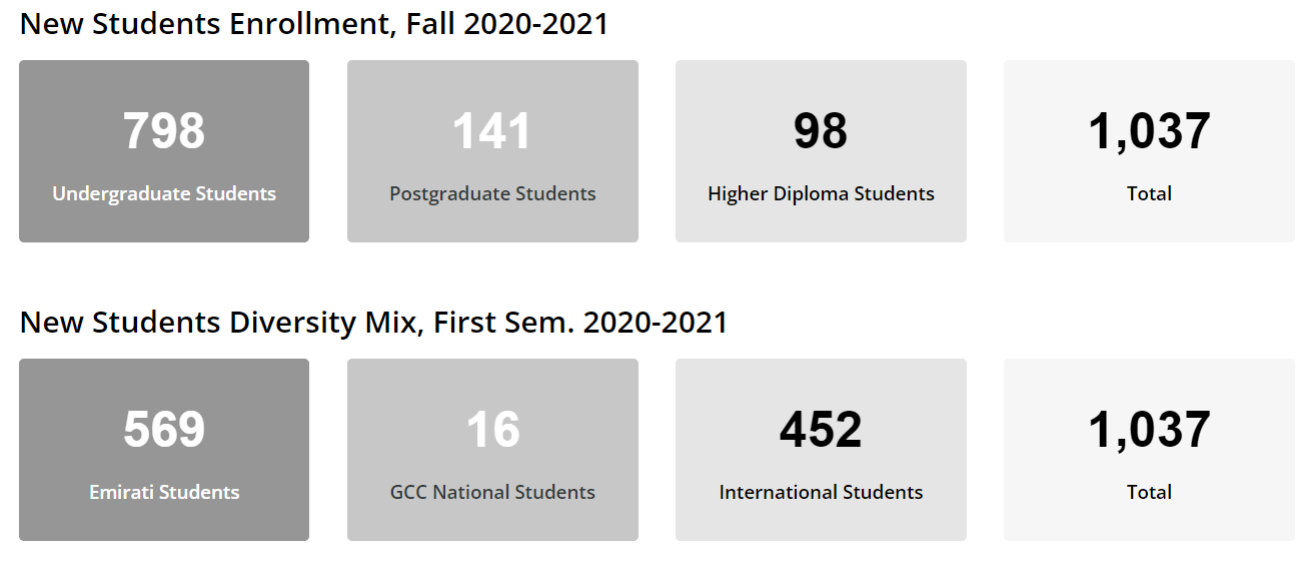
AAU's prior public 5.3.1 evidence includes a gender-disaggregated student-number snapshot for 2022-2023: 1,137 students in total, comprising 608 women (53.5%) and 529 men (46.5%). This published enrolment snapshot demonstrates the University's ability to disaggregate access data by sex. It is retained here as continuity evidence and is not presented as a 2024 application or acceptance rate.
Published population | Women | Men | Total |
AAU student-number snapshot, 2022-2023 | 608 | 53.5% | 529 | 46.5% | 1,137 |
Public evidence: E02 | E03 | E08
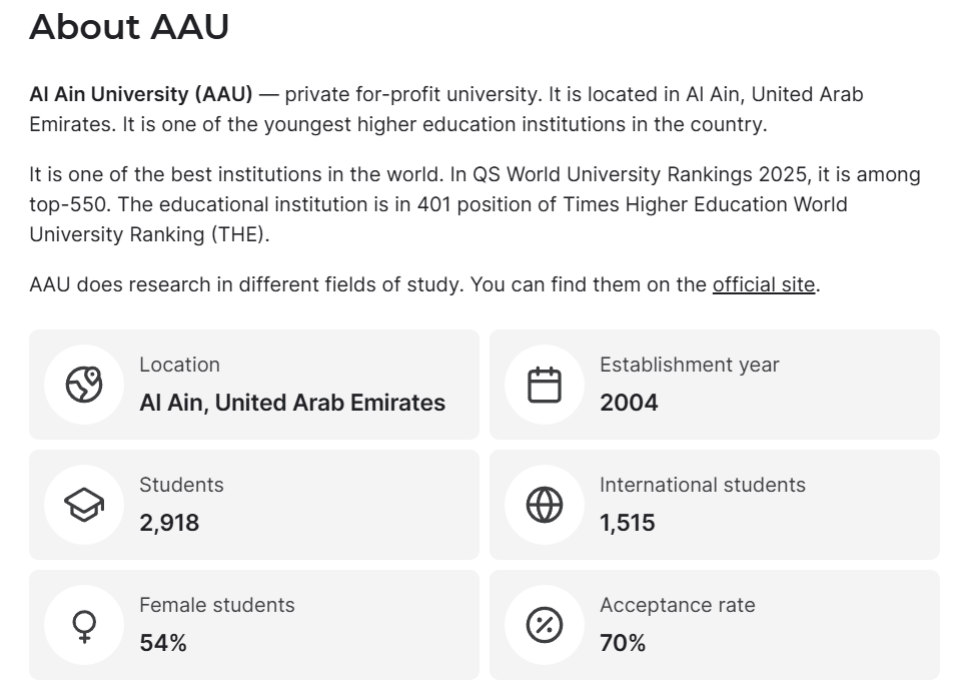
Facts and Figures
https://aau.ac.ae/en/facts-and-figures
2022-2023 Students’ Numbers
2022-2023 Student’s Number | Female Students | Male Students |
1137 | 608 | 529 |
100% | 53.5% | 46.5% |
AAU's open registration policy ensures that all individuals, regardless of their background, have the opportunity to pursue higher education. The university strongly believes in providing equal access to quality education, contributing to the principles of human rights and social justice.
Enrollment Statistics:
The results of AAU's inclusive admissions policy are striking, with a diverse student body that represents a broad spectrum of society. According to recent enrollment data:
- Female Students: The percentage of female students stands at an impressive 53.5%. This statistic is a testament to the university's commitment to empowering women through education, enabling them to excel in various fields.
- Male Students: Male students comprise 46.5% of the student population, highlighting the equal opportunities provided by AAU to individuals of all genders.
Unified Application Process:
One of the key factors contributing to these balanced enrollment numbers is AAU's unified application process. The application system treats all applicants equally, ensuring that every aspiring student, regardless of their background, can navigate the admissions process efficiently and fairly.
Equal Admissions Policy for Both Genders
AAU adheres to a non-discriminatory admissions policy that applies the same criteria and conditions to all applicants, regardless of gender. The university explicitly states that admission is based solely on academic qualifications (such as high school credentials) “regardless of gender, age, color, nationality or religion.”scribd.com. In practice, this means women and men face identical requirements for entry into any program – there are no separate or stricter conditions for female applicants. AAU evaluates all candidates purely on merit, as affirmed on its official SDG 5 pages: “AAU’s non-discriminatory admissions policy ensures all applicants, including women, are evaluated based on merit.”aau.ac.ae. Thus, female students enjoy equal opportunity in admission and enrollment. There is no gender-based discrimination in entry criteria, selection process, or fee structure – the policies are uniform for both genders. This equal-opportunity approach has helped AAU achieve a healthy gender balance on campus, with women applying and being accepted at rates comparable to their male peers.
Student Rights and Responsibilities
https://aau.ac.ae/publications/handbooks/al_ain_university_student_handbook__2021_2022_en.pdf
- Every student is entitled to experience a university environment that will enable pursuing the learning process easily.
- Every student has the right to practice his /her individual rights in the academic life in accordance with the University’s regulations and policies.
- Every student has the right to be knowledgeable of the University’s regulations and policies; that clarify his/ her rights, duties and responsibilities. As well as having the right to access this information through the University’s website, the Admission and Registration Unit and the Student Affairs Deanship.
- Every student must attend the classes and perform all academic requirements in accordance with the university’s instructions and regulations.
- Every student must adhere to the scientific research ethics and scientific integrity in all academic tasks, assignments, reports and research submitted in the registered courses.
- Every student must follow the instructions and regulations stated in the “Disciplinary and Penalties Regulations” enforced by the University.
- It is solely the responsibility of every student to update his/her data, especially the telephone number, in the Admission and Registration Unit for communication purposes.
- Every student is obliged to use the university’s official email to communicate with the university
and to check regularly to receive important news and announcements from the university.
- Every student must regularly check the university’s official website to stay updated with issues of interest, latest news, and important announcements.
STUDY COMPLETION
5. Study completion is tracked through progression and award records
Completion is measurable because each entrant receives an academic record that accumulates registration, attempted and earned credit hours, grades, academic standing and award status. Published academic regulations and completion requirements define the conditions for an award. Programme annual assessment reports review retention, progression and achievement, while graduation clearance closes the record and provides the outcome needed for completion-rate analysis by entry cohort and gender.
Completion-control point | Recorded evidence | Contribution to systematic tracking |
Cohort baseline | First-time entrant and programme registration | Defines the population against which completion is assessed |
Academic progression | Registered and earned credits, grades and academic standing | Shows movement through the programme and identifies interruption or delay |
Continuation | Retention, re-registration and follow-up records | Distinguishes continuing students from withdrawals or stop-outs |
Award eligibility | Required courses, total credit hours and minimum cumulative GPA | Applies a published completion standard consistently |
Graduation clearance | Final audit, award and completion date | Provides the verified completion outcome |
Institutional reporting | Programme reviews, annual reports, Fact Book and SDG 5.6.7 evidence | Supports gender comparison and trend monitoring |
Public evidence: E09 | E10 | E18 | E19 | E20 | E31 | E32 | E33 | E40 | E42
5.1 Public completion evidence and independent review
AAU publishes a dedicated SDG 5.6.7 evidence page addressing women's graduation rate compared with men's. QAA additionally confirmed that undergraduate and master's completion requirements are clearly detailed, that regulations are applied consistently from admission to graduation, and that non-registering students are followed up to support continuation. The public graduation record for the 18th cohort in 2024 supplies dated evidence that the award and completion process was operational in the formal evidence year.
Public evidence: E09 | E10 | E19 | E20 | E40 | E42
EQUAL CONDITIONS FOR WOMEN AND MEN
6. The same published standards apply to both genders
AAU separates equality of treatment from the measurement of outcomes. Women and men apply through the same published academic criteria, document checks, administrative process and fee schedule; register under the same academic rules; and complete under the same credit and cumulative-grade requirements. Gender-disaggregated measurement therefore tests outcomes under a common institutional framework rather than applying different entry or completion thresholds.
Decision point | Common published standard | Equality safeguard |
Undergraduate admission | Programme-specific secondary-school, subject, language and equivalency requirements | Criteria are academic and programme-based, not gender-based |
Graduate admission | Recognised degree, GPA and programme-specific requirements | The same published conditions govern all eligible applicants |
Document verification | Identity, certificates, equivalency and other required documents | One transparent checklist supports consistent decisions |
Fees | Published application, admission, registration, service and credit-hour charges | No separate fee schedule is stated for women or men |
Academic progression | Registration, grading, academic standing and study-time regulations | Equivalent academic obligations apply after entry |
Completion | Required curriculum, credit hours and minimum cumulative GPA | Award standards are gender-neutral and programme-specific |
Institutional rights | Non-discrimination, student rights, diversity and co-education frameworks | Gender cannot be used to deny academic opportunity or institutional service |
Public evidence: E11 | E15 | E16 | E17 | E19 | E20 | E26 | E28 | E34 | E36 | E37 | E42
COMPARABLE CONDITIONS, DISAGGREGATED OUTCOMES
AAU applies common academic and administrative rules while separately measuring women's access and completion so that differences can be identified without institutional discrimination.
PUBLIC CRITERIA AND PROCEDURES
7. Applicants can see the criteria, mechanism and documents before applying
AAU makes the access pathway visible through its website, policies, catalogs, handbooks and e-services. The published materials define undergraduate and graduate criteria, programme conditions, required documents, the online application route, registration rules, student classification, academic records, fees, scholarships and completion standards. This public guidance supports informed applications and makes consistent treatment auditable.
Required evidence topic | Public AAU channel | Information provided |
Criteria and conditions | General admission requirements, graduate requirements and catalogs | Academic eligibility, programme conditions and applicable minimum standards |
Mechanism and procedure | Online Admission, E-services Guide and Admission and Registration Unit | How to apply, submit information, receive decisions and obtain support |
Required documents | Required Documents page and admissions policies | Certificates, equivalency, identity and programme-specific evidence |
Registration after acceptance | Registration Rules and Student Handbook | Registration responsibilities, course load and academic calendar process |
Academic record and progress | Academic Records, classification and academic regulations | Grades, standing, progression and student-record governance |
Completion | Completion Requirements, Academic Regulations and SDG 5.6.7 evidence | Award requirements and public gender-comparison evidence |
Fees and assistance | Financial Information and Financial Aid pages | Entry, registration, service and tuition charges plus available assistance |
Public evidence: E12 | E13 | E14 | E15 | E20 | E24 | E26 | E27 | E28 | E29 | E30 | E31 | E32 | E33 | E34 | E35
7.1 Public accessibility supports accountability
The same information is available to women and men before entry. QAA's independent review confirmed that AAU's website and handbooks clearly communicate admission rules, required documents and financial information and that published information is accessible and aligned with regulatory expectations.
Public evidence: E12 | E14 | E26 | E27 | E34 | E42
TRANSPARENT ENTRANCE AND STUDY FEES
8. Entrance charges and study costs are published without gender differentiation
AAU's Financial Information page publishes programme credit-hour charges and administrative fees. The fee framework is expressed by programme, campus and service; it does not create a separate schedule for women or men. Publishing these charges alongside refund rules, grants and financial aid enables applicants to assess the cost of entry and continued study in advance.
Published charge | Current amount | Application to applicants and students |
Application fee | AED 1,000 | Payable upon enrolment under the published financial framework |
Admission fee | AED 1,500 | Payable upon admission |
Refundable insurance | AED 1,000 | Published refundable deposit |
Registration fee | AED 500 per semester | Applied through the standard semester-registration process |
Student card | AED 100 per year | Published annual administrative service |
Health service | AED 100 per semester | Published student-service charge |
Academic guidance | AED 100 per semester | Published academic-support charge |
Interactive activities | AED 1,000 per semester | Published semester activity charge |
Tuition | By programme and credit hour | Public tables show programme and campus rates |
8.1 Equal access to financial support
The same public framework also identifies academic grants, honours discounts, graduate support, family-related assistance and humanitarian aid. These routes support access and continuation without changing the academic conditions used to admit or graduate women and men.
FORMAL EVIDENCE YEAR: 2024
9. Dated evidence shows an operating system in the accepted cycle
The accepted 2024 cycle is supported by mutually reinforcing evidence. AAU's indicator page supplies the direct institutional response; the Annual Report 2023-2024 and July 2024 Quality Assurance Manual document the reporting environment; the 2024-2025 catalog and handbook publish the rules applicable around the cycle; QAA independently confirms the information-management and admissions framework; and the 18th-cohort graduation record demonstrates completion activity during 2024.
2024-cycle evidence | What it establishes | Relevance to Indicator 5.3.1 |
AAU SDG 5.3.1 page and evidence document | Direct institutional disclosure on tracking women's access | Primary indicator evidence |
AAU Annual Report 2023-2024 | Institutional activity and annual reporting for the accepted academic cycle | Evidence-year reporting output |
Quality Assurance Manual - July 2024 | Institutional assessment, reporting and quality responsibilities | Systematic measurement governance |
University Catalog and Student Handbook 2024-2025 | Published admission, registration and academic framework | Transparent criteria and common conditions |
QAA International Quality Review - February 2024 | Robust data collection, analysis, reporting, admissions and completion controls | Independent corroboration |
18th-cohort graduation - 2024 | Operating graduation and award process | Dated completion evidence |
Public evidence: E02 | E03 | E06 | E12 | E14 | E22 | E40 | E42
EVIDENCE-YEAR FOUNDATION
Public institutional evidence and an independent quality review confirm that applicant, entrant, progression and completion information was systematically managed during the 2024 evidence period.
CURRENT CONTINUITY
10. Public reporting and guidance remain current
AAU's later public record demonstrates continuity rather than replacing the formal 2024 evidence. The Fact Book 2024-2025 and Annual Report 2024-2025 continue the institutional reporting cycle; the 2025-2026 catalog maintains publicly accessible admission and academic regulations; current admissions, fees and e-services pages remain available; and the 19th-cohort graduation record confirms the continued operation of the completion pathway.
Continuity evidence | Current function | Tracking value |
Fact Book 2024-2025 | Consolidated institutional data for decision-makers and external reporting | Maintains comparable institutional datasets |
Annual Report 2024-2025 | Annual reporting on university performance and activity | Extends the reporting sequence beyond the evidence year |
University Catalog 2025-2026 | Current academic, admission and progression rules | Shows that transparent common standards remain in force |
Current admission and e-services pages | Accessible application criteria, documents and process | Maintains a traceable entry route |
Current financial-information page | Published programme and administrative charges | Keeps cost-of-entry information transparent |
19th-cohort graduation - 2025 | Continued completion and award activity | Confirms current lifecycle operation |
Public evidence: E05 | E07 | E13 | E24 | E26 | E27 | E29 | E30 | E34 | E41
10.1 Evidence integrity and defined measures
AAU preserves defined cohorts and reporting periods for valid rates. The 2022-2023 gender snapshot is identified as enrolment evidence, while application, acceptance or entry and completion measures use the corresponding applicant, decision, entrant and award records. Every reproduced figure retains its published institutional meaning.
Public evidence: E01 | E02 | E03 | E05 | E42
INSTITUTIONAL CONCLUSION
11. AAU systematically tracks women's access and completion
Al Ain University systematically measures and tracks women's application, acceptance and entry, progression and study completion through an institution-wide information and quality-assurance framework. The Admission and Registration Unit captures applications, decisions, entrants and awards; Banner and governed student records maintain the academic lifecycle; programmes and colleges review retention, progression and achievement; QAIRC coordinates institutional analysis, annual reporting, the Fact Book and key performance indicators; senior governance reviews results; and national reporting channels provide an external integrity check.
The measurement framework operates under common published conditions. Women and men use the same application mechanism, academic admission criteria, document requirements, published fee schedule, registration and grading rules, and programme completion requirements. Non-discrimination, student-rights, diversity and co-education provisions reinforce equal access. AAU's website, policies, catalogs and handbooks make the criteria, procedures, entrance fees, records framework and completion rules publicly accessible, while dedicated SDG pages publish women's access and graduation evidence.
FINAL RESPONSE: YES
AAU has a systematic, governed and publicly evidenced process for tracking women's applications, acceptance or entry and study completion under equal conditions for both genders.
11.1 Submission evidence summary
THE evidence theme | AAU evidence | Institutional result |
Women's applications | Online admission, applicant records, published requirements and Admission Unit governance | Women applicants can be counted and analysed by cycle and programme |
Acceptance and entry | Admission decisions, registration, entrant cohort and Banner student record | Women's acceptance or entry rate can be calculated consistently |
Study completion | Progression records, completion requirements, graduation clearance and SDG 5.6.7 evidence | Women's completion can be analysed against defined entry cohorts |
Systematic governance | QAIRC, annual programme reports, KPIs, Fact Book, annual report and national validation | Measurement is recurring, institution-wide and quality assured |
Equal conditions | Admission, fees, academic rules, completion rules and non-discrimination framework | Women and men are assessed under the same published standards |
Public transparency | Website, policies, catalogs, handbooks, fees and SDG evidence pages | Criteria, mechanisms, procedures and costs are publicly auditable |
Evidence year | AAU 2024 records plus February 2024 independent QAA confirmation | The framework is evidenced within the accepted submission cycle |
Public evidence: E01 | E02 | E03 | E09 | E10 | E15 | E21 | E22 | E24 | E34 | E42
PUBLIC EVIDENCE
12. Evidence register
The following public sources support the systematic measurement, equal-conditions, public-guidance, completion and evidence-year claims presented in this submission.
ID | Year/type | Public source | Evidence supported |
E01 | THE 2026 | Indicator number, evidence year, definitions and scoring | |
E02 | AAU SDG | Direct public institutional evidence for tracking access measures | |
E03 | AAU SDG | Downloadable 5.3.1 public evidence document | |
E04 | AAU current | Institutional SDG 5 framework | |
E05 | AAU 2024-25 | Current institutional data and reporting output | |
E06 | AAU 2024 | Annual report for the accepted evidence cycle | |
E07 | AAU 2024-25 | Continuing annual institutional reporting | |
E08 | AAU current | Public institutional facts and figures | |
E09 | AAU SDG | Women's graduation-rate comparison evidence page | |
E10 | AAU SDG | Downloadable graduation-rate comparison evidence | |
E11 | AAU SDG | Policy evidence supporting women's applications and entry | |
E12 | AAU 2024-25 | Published catalog for admissions and academic rules | |
E13 | AAU 2025-26 | Current catalog and continuity of published standards | |
E14 | AAU 2024-25 | Student handbook for registration and academic guidance |
PUBLIC EVIDENCE CONTINUED
12.1 Policies, quality assurance and records
ID | Year/type | Public source | Evidence supported |
E15 | AAU policy | Undergraduate admission criteria and process | |
E16 | AAU policy | Non-discrimination and equal treatment | |
E17 | AAU policy | Equal student rights and responsibilities | |
E18 | AAU policy | Accuracy, confidentiality and governance of student records | |
E19 | AAU policy | Academic regulations from registration to award | |
E20 | AAU policy | Published undergraduate completion requirements | |
E21 | AAU policy | AAU Quality Assurance and Institutional Effectiveness Policy | Quality assurance and institutional-effectiveness governance |
E22 | AAU July 2024 | Evidence-year quality assurance and assessment manual | |
E23 | AAU current | AAU Quality Assurance and Institutional Research Center duties | QAIRC institutional research and reporting duties |
E24 | AAU current | AAU Admission and Registration Unit duties and responsibilities | Admission and Registration Unit responsibilities |
E25 | AAU current | Admission and Registration goals and service objectives | |
E26 | AAU current | Public undergraduate admission requirements | |
E27 | AAU current | Public required-document checklist | |
E28 | AAU current | Public graduate admission requirements |
PUBLIC EVIDENCE CONTINUED
12.2 Application, registration, fees and completion
ID | Year/type | Public source | Evidence supported |
E29 | AAU current | Public online application mechanism | |
E30 | AAU current | Admissions e-services guidance | |
E31 | AAU current | Registration rules following admission | |
E32 | AAU current | Academic-record and progression framework | |
E33 | AAU current | Student classification and progression categories | |
E34 | AAU current | Published entrance, service and programme fees | |
E35 | AAU current | Financial aid and scholarship routes | |
E36 | AAU policy | Equal facilities and educational opportunities for both sexes | |
E37 | AAU current | Diversity, equal opportunity and respect | |
E38 | AAU current | Banner student e-services and registration environment | |
E39 | AAU policy | Protection and authorised use of institutional data | |
E40 | AAU 2024 | Evidence-year completion and 18th-cohort graduation | |
E41 | AAU 2025 | Current completion and 19th-cohort graduation | |
E42 | Independent 2024 | QAA International Quality Review of Al Ain University - February 2024 | Robust information management, admissions and completion controls |